


What does KNX stand for?
KNX Home Automation: A Complete Guide
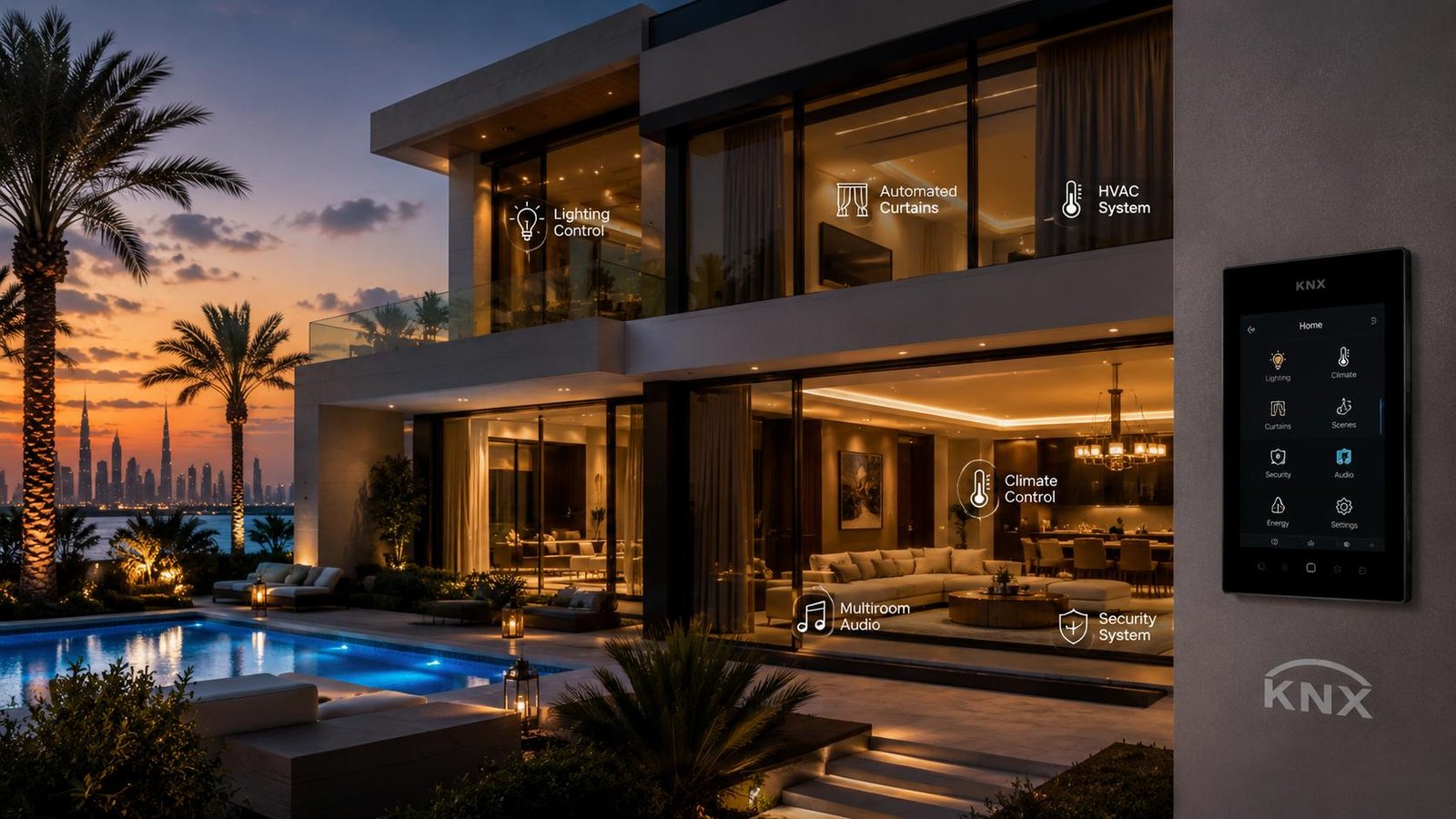
KNX is an acronym for “Key to KNX Exchange,” formerly spelled “Konnex,” which refers to an international communication standard in the field of building and home automation.
KNX enables a building’s electrical and smart devices, lights, switches, sensors, blinds, and HVAC systems, among others, as well as equipment for energy management to operate in collaboration within one unified automation system.
In India, if one is a homeowner, an architect, a builder, or a commercial project planner, then a KNX system offers a reliable means to build smart homes or intelligent buildings with complete and automated control.
What does the acronym KNX mean?
In the KNX acronym, K refers to German, which was the home country of the KNX Association back then.
We are now at a time where the worldwide building industry, particularly home automation systems, is adopting KNX as their preferred open standard.
To put it in simpler terms:
KNX is a system of communication that makes different smart devices in the building collaborate with each other.
For instance, when a person enters a room, the sensors of a KNX system can automatically activate some lights, adjust climate settings, or even trigger a pre-programmed scene.
What Is KNX Home Automation?
KNX home automation is the use of a common communication medium to connect and control various building functions.
Rather than individually controlling each device, users have the option to set up automated scenes and centralized controls.
A KNX system is very multifunctional and includes:
- Smart lighting
- Lighting scenes
- Motorized curtains
- Blinds and shutters
- Heating and cooling
- Controlling HVAC
- Sensors for human presence
- Monitoring energy
- Integrating with security systems
- Smart switches
- Touch panels
- Scheduling automation
Because of its versatility, KNX is a reliable choice
How Does KNX Work?
A typical KNX installation includes sensors, control units, actuators, and a communication network.
1. Sensors
Sensors gather real-time data from the environment.
A list of some examples:
- Motion sensors
- Presence sensors
- Temp sensors
- Luminescence sensors
- Door and window sensors
2. KNX Bus or Communication Network
The devices are interconnected through the KNX system. The medium through which the KNX works can vary depending on the kind of installation; the KNX could utilize twisted-pair wiring or even IP-based communication.
4. Actuators
Actuators are devices that execute commands and manipulate electrical appliances.
For instance, a lighting actuator can change the brightness or turn a light on/off depending on the input that it gets.
Control elements through which a user interacts with the system are the following:
- Wall-mounted switches
- Touchscreen interfaces
- Smartphones/tables
- Building monitoring systems
- Main control panels
Reasons Why KNX Is Widely Adopted for Smart Homes
KNX, as a standardized building control method, is a major reason behind its popularity: it is a solution that has been conceived from the needs of building automation and integration.
One of KNX’s key characteristics is its independence of a single manufacturer. Any KNX implementation that has been thought out correctly should consist of devices that are compatible and come from varying manufacturers.
Being the case, not only architects or electrical engineers but also homeowners are in the position to choose the best-suited smart devices when putting together their smart building.
The main advantages:
Device Compatibility: The devices that meet the KNX standards can communicate and work together.
Expandability: There is no upper limit to the systems’ size or number of devices, and it is quite simple to grow the home automations.
One-to-one control and automation: One device can be the center of the operation for all the home automation of the building functions.
Automatic control: With programmed logic and sensors, an action may just get triggered upon a condition.
Optimized energy consumption: For lighting and HVAC systems as well, KNX can significantly reduce energy waste.
Designed around a property: The system’s design can be around the house’s peculiar needs.
Apart from that, KNX also has flexibility features that ensure that the system keeps working properly in different situations, and it also has a modular design that will enable new equipment, e.g., a smart light or an irrigation timer, to join the network seamlessly, without making any changes to the rest of the setup. In a nutshell, KNX is the system that is easy to change even over the years and which is quite safe.
K NX is an extremely user-friendly system, especially in terms of programming, and it can be quite easy or quite hard according to what level of automation you are planning; however, in most of the cases you are just going to do basic scenes or light controls.
K NX is not only about technical and professional level of implementation but KNX can also be very convenient and user-friendly for home owners and it is also a good investment that will be lasting over decades with only minimal updates needed to the KNX hardware and software as well as minimal replacements for components of the KNX system itself.
So, to wrap it up, KNX is a system that is quite easy to modify, even after many years, and also quite a secure system.
Implementation of KNX in Luxury Houses in India
One of KNX’s biggest markets is in the luxury housing segment, such as villas, apartments, farmhouse development, and premium housing projects in India.
A luxury villa near the capital city of Delhi that uses KNX automation may manage the following through KNX:
- The illumination of the drawing room
- illumination of the bedroom
- automated opening of the curtains
- air-conditioning control
- lighting at the gate
- lighting of the garden
- motion detection
- monitoring of energy usage
- scene controls
Imagine for a moment that the house owner sets up a “Wake-up” scene that includes the opening of the chosen Curtains,switching on the lights and adjustment of some other connected functions.
KNX vs Traditional Electrical Switching
Electric switches in traditional systems generally operate only one light in one part of the house. A change in any one spot usually does not affect other areas and is not linked with the rest of the house.
The KNX solution allows you not only to program the system but also to automate actions with the help of different devices communicating through a common bus.
For example:
Traditional system
Switch → Light
KNX automation
Sensor → KNX system → Lighting actuator → Light
Thanks to such a scheme, the light switch will react not only to your direct action but also be dependent on such factors as motion detection, the day and night periods, light intensity detection, and even the pre-defined settings.
KNX and Smart Lighting
Lighting represents the main activity area of the KNX technology.
A smart lighting system based on the KNX protocol is able to:
- Switch lights on/off with a toggle
- Change light brightness level
- Save lighting scenarios (e.g., dinner lighting, working lights, ambient lighting)
- Switch on the light automatically (by movement, at dusk, etc.)
- Control lighting with a motion sensor (light switches only the areas needed)
- Dim light based on daylight
- Change light according to timetable (morning time, bedtime)
- Provide for a connection to high-end lighting systems (luminaires of different suppliers working together)
It is a great advantage to be able to combine large-scale building automation solutions with precision lighting management through KNX integration.
It can be especially convenient for smart luxury apartments, hotel rooms, and office spaces, as well as shops and commercial facilities.
KNX and Energy Efficiency
Another reason that makes KNX an interesting solution in building automation is the fact that it leads to a reduction of energy consumption.
Homes that include sensors are intelligent buildings. These devices can detect room occupancy, and based on that, they can activate or power down any lights or air conditioning unit.
KNX technology helps support the following energy-saving plans through its functionality:
- Lights (turning them on/off or dimming them depending on what’s needed)
- Air conditioning
- External blinds
- Energy usage
- Timing systems
- Occupancy sensors
Is KNX Suitable for Existing Homes?
KNX technology works for both new houses and remodeled ones, although how it is installed depends on how the house is wired already and whether the functions you intend to implement are already available.
In case of building a new house, you can consider making the KNX setup part of the electrical design phase.
When dealing with a house that is already built, the person who installs KNX systems can
Look into the possibility of using wired KNX, KNX IP, wireless KNX technology, or a mixed installation with various technologies.
Before making a choice, the professionals at the site are supposed to carry out a technical audit.
Frequently Asked Questions About KNX
What does KNX stand for?
KNX stands for Konnex, and it’s used as an international standard in the field of home and building automation.
What is KNX used for?
Through KNX, building functions like lighting, HVAC, blinds, curtains, sensors, energy management, and other electrical systems can be automated and integrated.
Is KNX a home automation system?
Correct. KNX is recognized as one of the most popular standards for home and building automation that works for residential as well as commercial applications.
Is KNX better than Wi-Fi smart home systems?
They are meant to cover different areas of application. KNX, in this case, is a standard for building automation, while the latter is an internet connectivity method usually used to hook individual smart devices. A large or a professionally constructed project may benefit more from a KNX solution, as it will offer a more defined automation setup.
Can KNX control lights?
Of course. KNX, by means of a compatible actuator, has the ability to control lighting and also to work together with lighting-control systems such as DALI.
Can KNX control air conditioning?
Yes. KNX, if connected correctly with a compatible HVAC system, will be able to carry out the automation of temperature control and be part of it.
Is KNX suitable for luxury homes?
Absolutely. KNX is perfect, for example, for luxury villas, premium houses, or even large residential complexes where several functions of the building need to be coordinated by means of the system.
Is KNX expensive?
If you want a detailed estimate for KNX you will get it after your project specification as the price is based on property size, the number of devices, wiring, control requirements, equipment, programming, installation, and so on.
Conclusion: What Does KNX Stand For?
KNX is an acronym for Konnex. KNX represents an international standard for home and building automation which facilitates communication between various devices and building systems, thereby enabling them to operate together within a coordinated automation system.
KNX is capable of providing all necessary control functions at the level of smart lighting, curtains, HVAC, sensors, energy management, and automated scenes thus, it is a great basis upon which to build a professionally designed smart home or intelligent building.